The term “GTM engineer” gets thrown around as if it means “the person who knows Clay.” It doesn’t. A GTM engineer builds the system that turns raw market signals into qualified, personalized, orchestrated outreach at scale, and the tools are the least interesting part of that. This is the operating system underneath the role: the sequence that separates a real GTM engineering function from a pile of expensive subscriptions.
The mnemonic that runs through the whole discipline is simple, and it is worth committing to memory because every decision in the function maps back to it: Signal → Enrichment → Personalization → Orchestration. Everything below is that loop, built properly and instrumented so it improves every cycle.
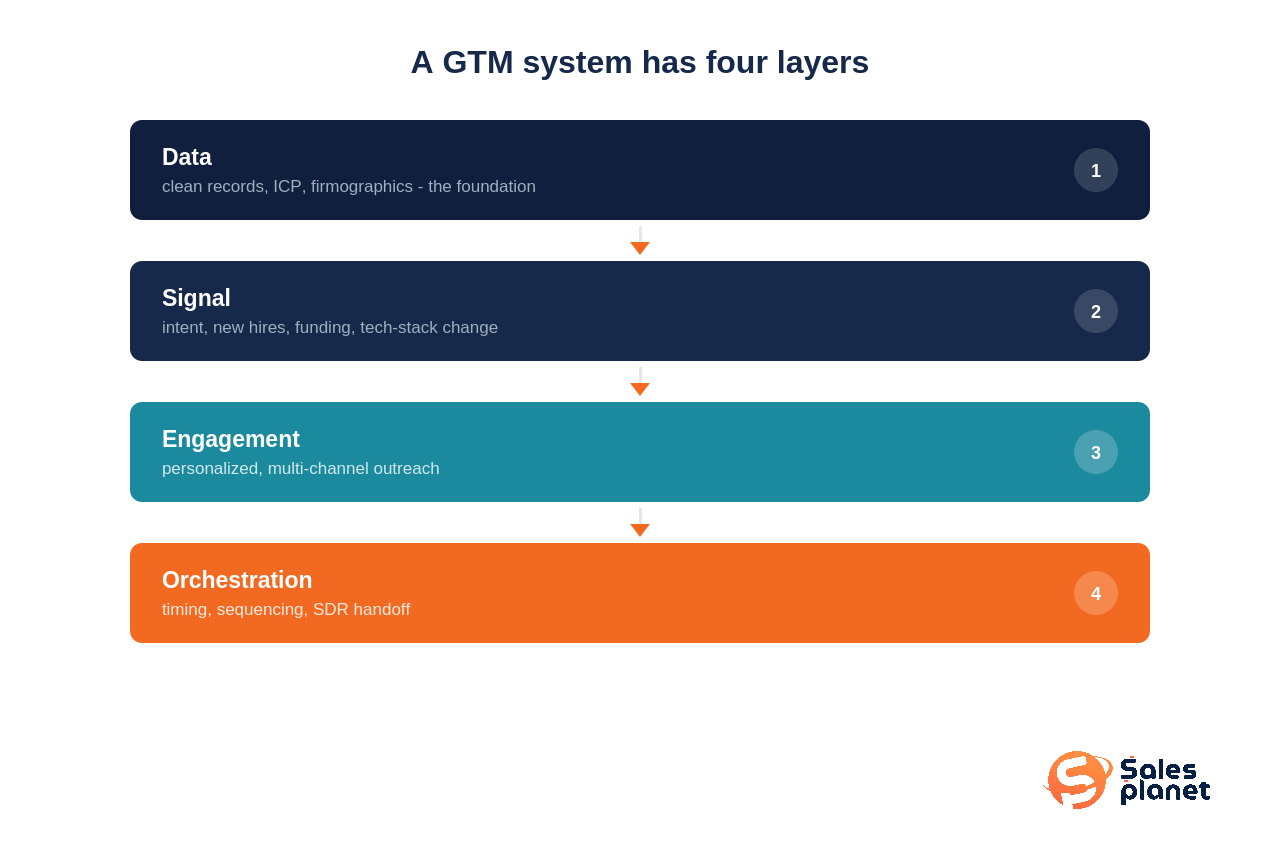
A GTM system has four layers
Data
clean records, ICP, firmographics – the foundation
Signal
intent, new hires, funding, tech-stack change
Engagement
personalized, multi-channel outreach
Orchestration
timing, sequencing, SDR handoff
Data → Signal → Engagement → Orchestration. Each layer feeds the one below it. Teams that buy an Engagement tool without a Signal layer are automating the second step of a system whose first step doesn’t exist.
The old outbound world started with a static list and blasted it. GTM engineering starts with a signal: a hiring spike, a funding round, a tech-stack change, a leadership move – that tells you an account is likely in-market right now. The signal is the whole edge; without it you are just automating spam faster.
- Define the two or three signals that genuinely correlate with a buying window in your business.
- Build the sources that capture them: job boards, funding feeds, tech-stack detection, intent data.
- Reject the temptation to target everyone; a signal that fires for every account is not a signal.
PRO TIP
If you can’t name the specific signal that made an account worth contacting today, don’t contact it today. Signal discipline is the entire difference between GTM engineering and cold spam.
2. Enrich until the record can carry a real message
A name and an email cannot support personalization. Enrichment is the layer that turns a thin lead into a record rich enough to say something specific: company context, role details, recent activity, and the signal that surfaced them. This is where tools like Clay earn their keep, orchestrating dozens of data sources into one usable profile.
The discipline at this stage is knowing exactly what data your message needs and enriching for that – no more, no less. Teams new to the tooling often over-enrich, paying for dozens of data points that never make it into a single sentence of outreach. Start from the message you want to send, work backwards to the fields it requires, and enrich only those. Enrichment is a means to relevance, not a collection hobby.
The economics here are the part CEOs get wrong. The tooling is cheap; the expertise to assemble it is not. A starter stack – Apollo at around $99/mo plus HeyReach at ~$79/mo – runs under $200 a month. Add Clay for enrichment in phase two (from ~$149/mo) and a full stack lands around $400-600/mo. Set that against a single SDR salary of $2,000-4,000/mo and the math is not close. What actually costs money is the time to build and tune it – which is exactly why the GTM engineer role exists.
This is why Clay has become the default tool here 84% of GTM engineers now use it, more than any other platform in the stack.
The stack is cheap; headcount is not
A full GTM stack costs a fraction of a single SDR’s salary. The real investment is the expertise to assemble it – which is why a GTM engineer at 10–15 hrs/week beats another headcount for most sub-50-person teams.
KEY METRIC TO TRACK
Enrichment coverage – the percentage of records that reach the data completeness your messaging actually requires. Low coverage means your personalization layer is running on guesses.
3. Personalize on relevance, not on tokens
Inserting {{first_name}} is not personalization – it is a mail merge from 2005. Real personalization ties the message to the signal and the enriched context: why this account, why now, why this specific problem. The bar is whether a human reading the message would believe it was written for them, because functionally it was.
- Anchor every message to the triggering signal – the reason you reached out now.
- Use enriched context to make the relevance concrete, not decorative.
- Let AI draft at scale, but hold the relevance bar a human would.
4. Orchestrate across channels as one motion
The final layer sequences the touches: email, LinkedIn, and the handoff to a human rep – into a coordinated motion instead of disconnected blasts. Orchestration decides the timing, the channel order, and the exit conditions, so a prospect experiences one coherent conversation rather than three tools talking over each other.
PRO TIP
Design the exit conditions as carefully as the entry ones. A sequence that can’t tell when to stop – because someone replied, booked, or opted out – will burn the reputation the first three steps earned.
Orchestration is also where the human belongs. The system should handle the repeatable choreography: timing, sequencing, channel switching, stopping on a reply, and then hand a warm, context-rich prospect to a real person at exactly the right moment. The goal is not to remove humans from outbound; it is to spend their time only where judgment and relationship actually matter, which is the conversation, not the coordination. A well-built orchestration layer makes your reps more human, not less present.
5. Instrument the loop and feed it back
A GTM engineering system that doesn’t measure itself decays. Track which signals convert, which enrichment sources are worth their cost, and which personalization angles land – then feed that back into step one. The operating system is a loop, not a pipeline, and the compounding advantage comes from tightening it every cycle.
The single most useful view is conversion by signal type. It tells you, in one chart, where your edge actually lives, and it is almost never evenly distributed. Most teams find that one or two signals carry the whole motion while the rest are noise dressed up as sophistication. When you can see it, the decision makes itself: double down on what converts, cut what doesn’t, and stop paying for data sources that never earn a meeting.
Signal-to-meeting rate by signal type
Not all signals are equal. Funding rounds and executive hires (highlighted) convert an order of magnitude better than no-signal cold outreach. Instrument the loop and let the data reallocate your effort.
KEY METRIC TO TRACK
Signal-to-meeting rate by signal type – which triggers actually produce pipeline. This is the number that tells you where to double down and what to cut.
Wrapping up GTM engineer
GTM engineering is not tool ownership – it is the disciplined operation of Signal → Enrichment → Personalization → Orchestration, instrumented and improved every cycle. Build the loop in that order, keep signal discipline sacred, hold personalization to a human bar, and let the conversion data reallocate your effort. The tools change every year; the operating system is what makes them worth buying. Which layer of your current outbound is the weakest link?
This is exactly the kind of GTM engineering system we help IT and SaaS companies build.