Maria was the obvious hire. Ten years at a hyper-growth SaaS company, a track record of scaling an outbound team from 5 to 40 reps, references that glowed. Hiring a head of sales had never felt so easy: the founder signed the offer within a week. Six months later, pipeline was flat, two good reps had quit, and everyone was quietly asking what went wrong.
Nothing was wrong with Maria. She was excellent – at scaling a high-velocity SaaS outbound machine. The company that hired her was a boutique IT services firm that won on relationships and referrals, with six-month sales cycles and deals closed over dinner, not demos. She was a brilliant answer to a question the company had never actually asked.
You don't hire a Head of Sales. You hire a Head of a specific sales motion, and most founders never name which one.
The mismatch is the most expensive hiring error in sales, and it is almost invisible on a résumé. A CV shows you what someone achieved; it does not show you the conditions that made the achievement possible, or whether those conditions exist in your company. Below is the playbook for making sure the leader you hire is the one your business actually needs.
Step 1: Before hiring a head of sales, diagnose your motion
Purpose: name the sales motion that actually generates your revenue, so you hire against reality instead of aspiration.
KEY QUESTION
Where did our last ten closed-won deals actually come from – outbound, inbound, referrals, or partnerships?
Pro Tip
The strongest signal is a candidate who asks more questions than they answer. A leader who diagnoses before prescribing in the interview will diagnose before prescribing on the job.
Step 4: Align expectations in writing before day one
Founders love to hire for the motion they wish they had. If 80% of revenue comes from referrals, hiring an outbound-SaaS leader is not ambition – it is a bet that they will rebuild your entire go-to-market. Sometimes that bet is right. But you should make it consciously, not by accident, and you should fund the rebuild rather than expecting it to happen for free while the existing motion keeps the lights on.
The diagnosis is also a forcing function for honesty about your own company. Sometimes the motion that made you money is one you are quietly ashamed of – too founder-dependent, too reliant on a single channel, not “scalable” enough to put in a pitch deck. Hiring a leader to replace it, rather than to strengthen it, is how companies accidentally dismantle the one thing that was working. Name the real motion first; decide whether to grow it or replace it second.
Step 2: Separate the archetype from the accolades
Purpose: map the candidate’s real strengths to your stage, not to their last company’s stage.
Most sales leaders are strong in one quadrant and passable in the others. The trick is to locate both your need and the candidate on the same map – company stage on one axis, how much process already exists on the other, and hire for the box you are actually in.
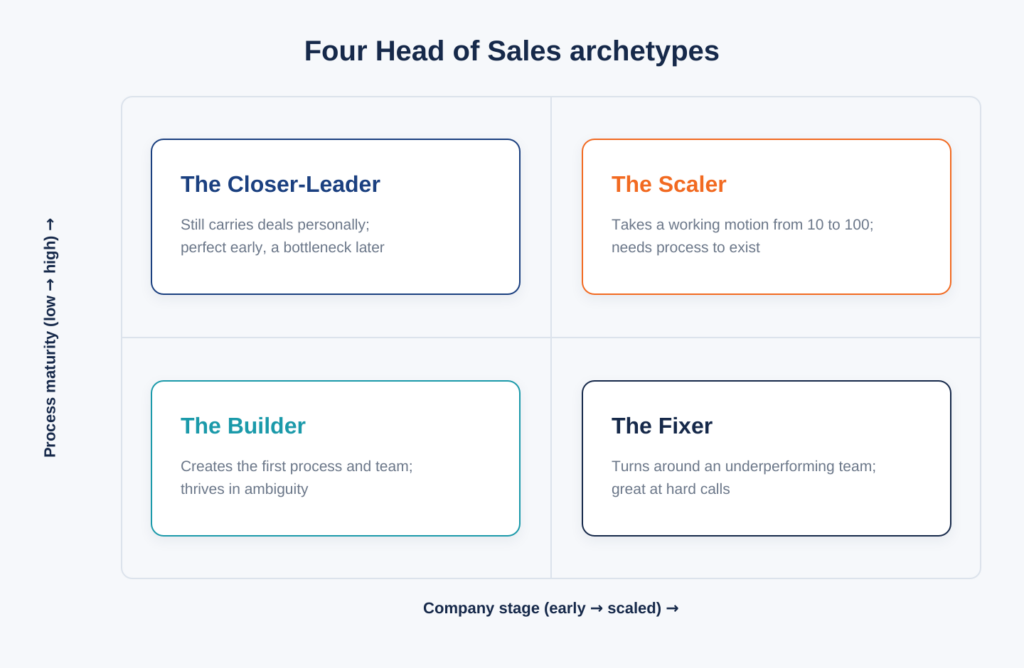
Maria was a Scaler (top-right) dropped into a Builder’s job (bottom-left). The archetype mismatch – not her ability – is what sank the first six months.
Maria was a Scaler dropped into a Builder’s job. She reached instinctively for the levers that worked at her last company – SDR pods, high-volume sequences, tight stage gates – in a business whose deals were won by a partner having lunch with a CTO. Her instincts were excellent and exactly wrong for the context.
Scale changes the archetype you need, too. A 20-person shop hiring its first sales leader almost always needs a Builder or a Closer-Leader – someone who will personally close while assembling the first repeatable process. A 300-person outsourcing company doing several million in revenue is a different problem entirely: the motion exists, the question is whether to scale it or defend it, and that points to a Scaler or a Fixer. Reading the archetype without reading your own size is how founders hire a brilliant Builder into a company that needed a Scaler, or vice versa.
Research backs this up. Stanford’s Mark Leslie and Charles Holloway, in their work on the sales learning curve, argue that early-stage companies should hire salespeople comfortable with ambiguity – and only bring in more traditional sales profiles once the sales model is proven.
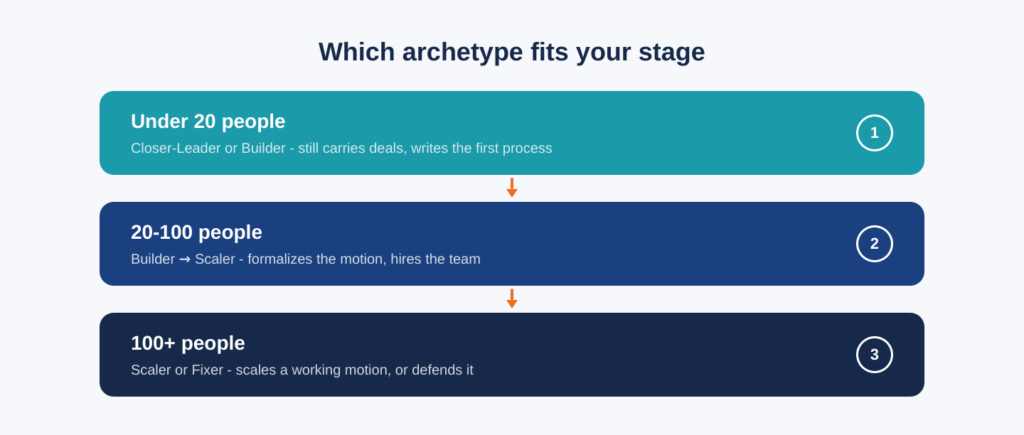
The right hire is a function of your size and the state of your motion. Match the archetype to the row you are actually in – not to the row you aspire to be in next year.
Step 3: Test the fit with a real scenario
Purpose: watch the candidate solve your actual problem before you bet the quarter on them.
- Give them a redacted version of your real pipeline and ask what they would change in the first 30 days.
- Describe your actual motion and ask how they would grow it – not how they would replace it with the one they know.
- Listen for whether they adapt to your context or reflexively install their old playbook.
The scenario exercise does something a résumé and a reference call never can: it shows you how the candidate thinks when the answer isn’t rehearsed. A Scaler forced to reason about a referral-led services business will either light up at the puzzle or visibly reach for the only toolkit they know. Both reactions are information you cannot get any other way, and both are far cheaper to learn in an interview than in the second quarter of their tenure.
Purpose: eliminate the silent assumptions that cause month-six blowups.
Write down the motion, the mandate, the first-100-day priorities, and the decisions that stay with the founder. Both sides sign it. It feels bureaucratic and it saves the relationship – because the failure mode is almost never a dramatic fight. It is two people who quietly assumed different things and only discovered it when the numbers came in. A one-page written alignment is the cheapest insurance you will ever buy against a six-figure mis-hire.
There is a second, subtler benefit to writing it down: it forces you to discover your own uncertainty before the candidate does. Founders who sit down to specify the mandate often realize they have never actually decided whether they want a builder or a scaler – they wanted “someone great” and assumed the details would sort themselves out. The document is where that vagueness gets caught, while it is still free to fix.
Wrapping up
The Head of Sales you hired isn’t the one you needed whenever the offer was written against a title instead of a motion. Diagnose how your revenue is actually made, place the archetype on the map against your stage, test against a real scenario, and align the mandate in writing. Do that and Maria’s story – a great leader failing at the wrong job – stops being one you have to live through.