Every B2B founder eventually hits the same wall: the first 10 to 100 customers close on the founder alone, until the founder’s 24 hours run out. This is the sequence that gets you past it without becoming one of the 70% who get the first hire wrong.
Sources: Lemkin, Roberge, Kazanjy, Ross, Blond, Janz 10 steps · 3 parts · 6 diagrams
Every B2B founder, whether in IT outsourcing or SaaS, eventually hits the same wall. You closed your first 10, 20, sometimes 100 customers yourself, on expertise, relationships, and sheer belief in the product. And that is exactly right: nobody sells better than the founder in the early days. But the model has a built-in ceiling: your 24 hours. At some point you can no longer cover sales and operations at the same time, the pipeline sags the moment you disappear into a project or a negotiation, and the instinct kicks in to “hire someone for sales” so you can finally breathe.
This is where it most often breaks.
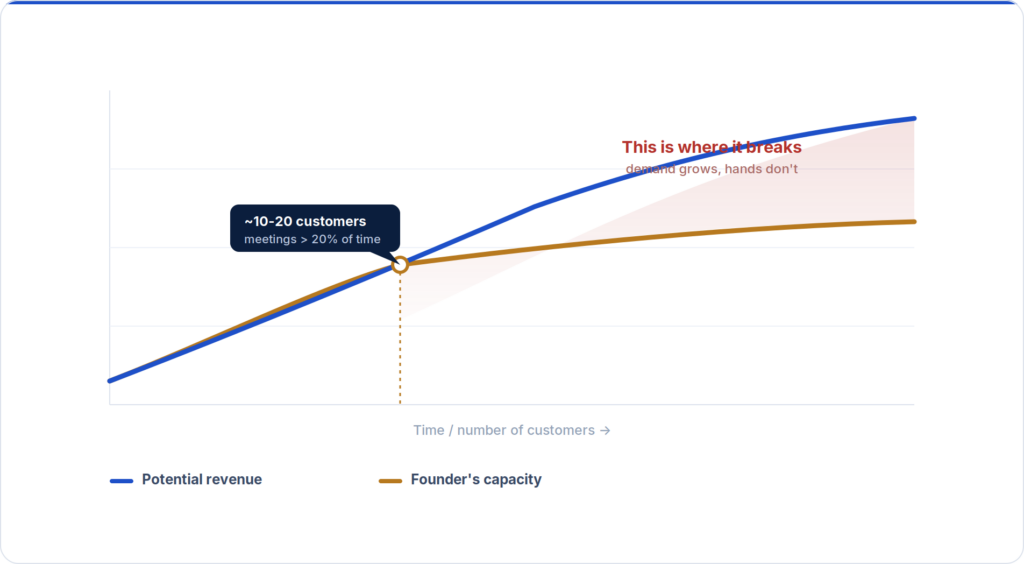
You’re not hitting a market ceiling – you’re hitting your own 24 hours. The hiring trigger isn’t “it got hard”; it’s a concrete signal: customer meetings eat more than 20% of your time.
70%
Roughly 70% of first sales-leadership hires do not work out, according to SaaStr. And the problem is almost never that you hired too late.
And the problem is almost never that you hired too late. Founders hire the wrong role, the wrong person, in the wrong order, and often answer the wrong question entirely.
This guide distills the people who have made this transition and mapped it systematically: Jason Lemkin (SaaStr), Peter Kazanjy (Founding Sales), Mark Roberge (former CRO of HubSpot, author of The Sales Acceleration Formula), Sam Blond (former CRO of Brex), Aaron Ross (Predictable Revenue, architect of Salesforce’s outbound machine), and Christoph Janz (Point Nine Capital). What follows is a three-part sequence: what to do before the hire, how to hire, and what to do after.
The sequence, at a glance
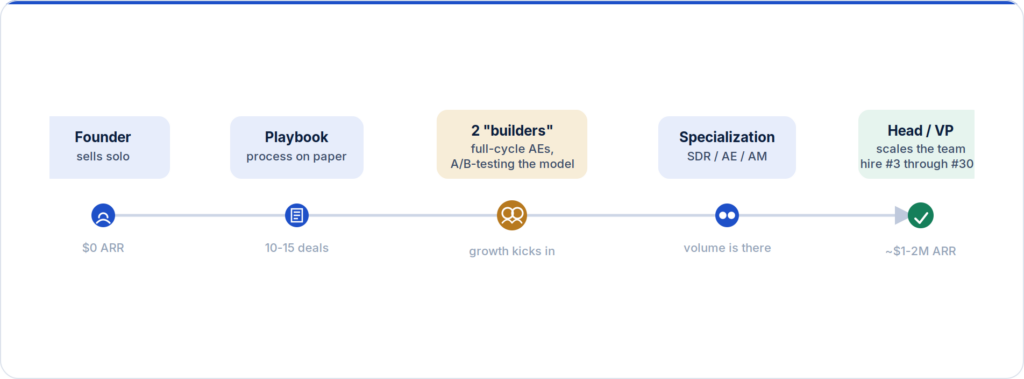
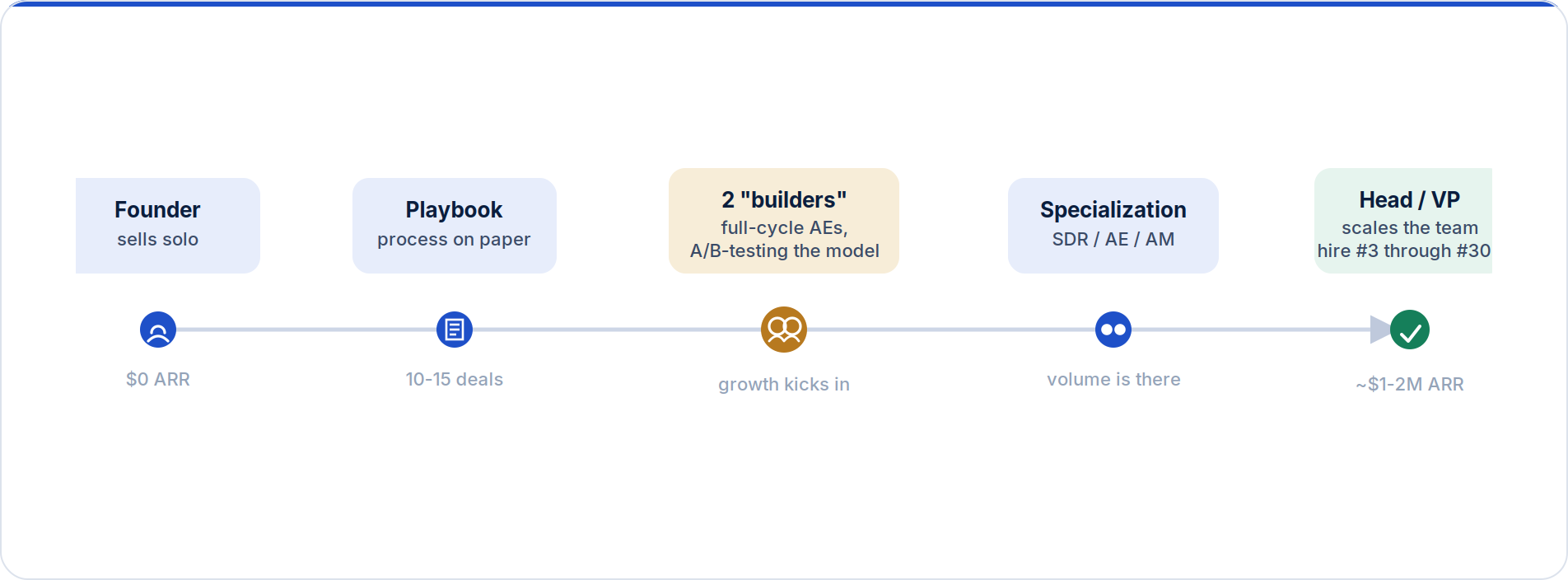
Sales-led is a sequence of five stages, not one hire. Skip a stage and you’re headed into that 70% failure rate.
Part I - Before the hire
Step 0. Choose the sales motion first, not the salesperson
The biggest mistake happens before the interviews even start: the founder assumes the answer to “sales have stalled” is “hire a rep.” Sometimes the right answer is no rep at all.
Christoph Janz’s “five ways” model (one of the most cited frameworks in SaaS history) says that your average contract value (ACV) dictates your acquisition channel, your sales type, and your team structure. You can test it in a single spreadsheet row: divide your target revenue by your ACV and you get the number of customers you need, and with it the sales motion you are obligated to run.
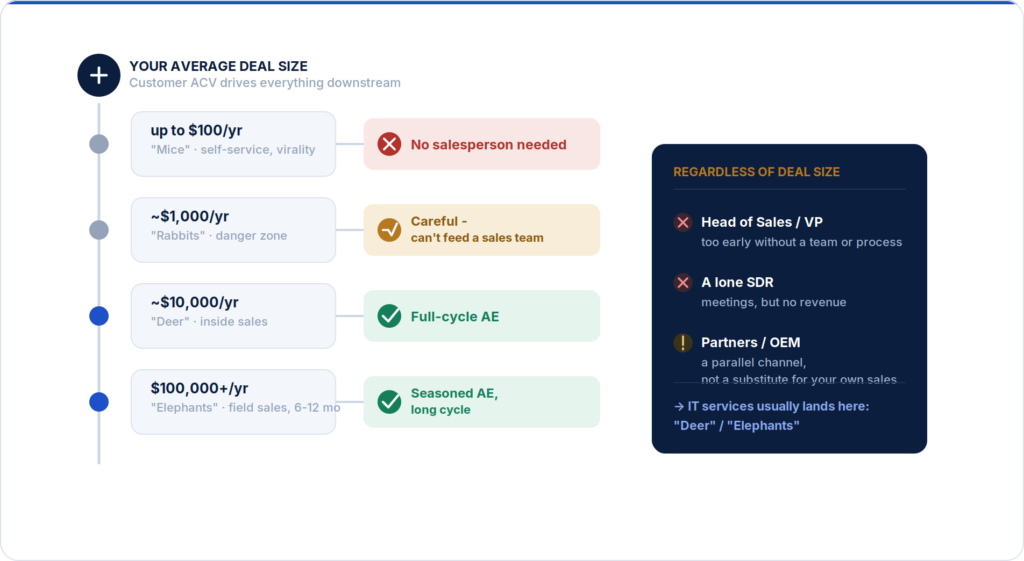
The gap between product and motion is fatal: a cheap product sold through expensive direct sales, or an enterprise product sold through self-service, both break at the same point – CAC stops matching the deal size.
- Very low ACV (tens of dollars a year): virality and advertising. A salesperson simply does not exist here.
- Low ACV (~$100/year, “mice”): pure self-service and high-volume inbound marketing with very low CAC. A human rep cannot make the economics work.
- ~$1,000/year (“rabbits”): the “danger zone.” You cannot yet afford a real sales team, but pure self-service is no longer enough. The trickiest segment of all.
- ~$10,000/year (“deer”): inside sales, selling over phone and video.
- $100,000+/year (“elephants”): field sales, seasoned account executives, and 6-to-12-month cycles; you need on the order of a thousand such deals to reach $100M.
The gap between product and motion is lethal. A cheap product sold through expensive direct sales, and an enterprise product pushed through self-service, both break at the same point: acquisition cost stops matching the deal size. And separately: “we take every customer” without a deliberate choice of motion is guaranteed broken unit economics that no single lever will fix.
What about partners, that tempting idea of “hand off sales and stop suffering”? A partner or OEM channel is a deliberate distribution choice for a specific segment, not an emergency exit. Hand everything to partners early and you lose three things you cannot build a system without: margin, customer data, and control over pipeline quality. Partners are a strong parallel channel, not a replacement for your own sales during the transition.
For IT services and outsourcing the deal size is almost always high (“deer” and “elephants”), so sales-led is justified. But you still have to run Step 0, so you do not build a sales team where there is nothing to feed it, and so you do not confuse “we need a rep” with “we need marketing” or “we need a better product.”
Until you have closed deals personally, you do not know how people actually buy from you, which means you cannot teach it. A rep hired before that point will post zeros for months, because the closing still falls to the founder. That is not a hire; it is an expensive way to discover that you never learned to sell systematically.
The move to sales-led does not start with a job opening; it starts with a document. Roberge breaks the sales methodology into three elements you need to extract from your head: the buyer journey (how the customer moves toward a purchase), the sales process (your repeatable stages that meet that journey), and the qualifying matrix (the criteria by which a lead passes or gets filtered out). Add a clearly defined ICP, a list of 3 to 4 real reasons people buy from you, and the common objections with your answers. That is your playbook. Playbook first, then the job description, not the other way around.
Step 1. Sell it yourself, and get the process out of your head
Step 2. Know exactly when it is time to hire
Lemkin’s trigger is simple: start hiring when customer meetings begin to eat more than 20% of your time as a founder. Customers love talking to the founder, so use that advantage while you are still in sales, but do not let it become your only job.
Sam Blond sets a stricter discipline: hiring more reps only makes sense when the growth bottleneck is specifically a lack of hands for existing demand; if demand is thin, new reps just spread it thinner and drop everyone’s productivity.
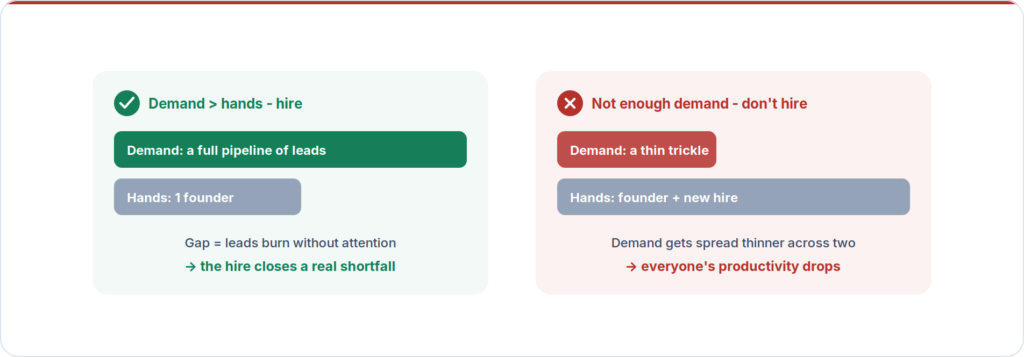
And his warning that saves you from a whole class of mistakes: you do not fix a stalled sales motion by adding PLG; if growth has stalled, you have most likely fallen out of product-market fit. In other words, sometimes “sales aren’t working” does not mean “hire a rep,” it means “go back to the product and the market.”
Part II - The hire itself
A stalled sales motion isn’t fixed by adding people. If growth has stalled, the likely cause is product-market fit – not a lack of hands.
Step 3. The first hire is a "builder," not a VP. And you are not hiring for revenue
The temptation to hire a “grown-up” Head of Sales or VP is strong; it feels like an experienced leader will build everything for you. Early on, that is an expensive mistake: a leader needs a ready team and a working process. Hire a VP before that and you are essentially paying an executive salary to have someone grope for product-market fit and write strategy decks instead of selling. Their moment comes later, usually once two individual contributors are consistently hitting quota (a rough marker is ~$1-2M ARR), and then their real job is to recruit and ramp reps number 3 through 300.
The first hire, by contrast, is a “builder”: in Lemkin’s phrase, low maintenance, high output. Someone who will set up their own CRM, write the first outreach themselves, and figure it out without the sales ops and ready-made collateral that people from big corporations are used to. In Kazanjy’s terms, the person who can take a half-baked product, build a coherent narrative around it, present, listen, and iterate. Kazanjy also warns about the trap: founders are drawn to stars from blue-chip companies, and reps from mature org structures find it extremely hard to switch into scrappy mode without infrastructure.
And the key shift in perspective from Roberge: the main value of your first rep is not the early deals or the revenue they bring, but how much they accelerate the company toward product-market fit. You are hiring a co-researcher of the market, not a “quota body.”
Step 4. The counterintuitive profile: the aggressive "closer" fails
This is the most underrated conclusion in the whole topic, and the most valuable. Roberge, an engineer by training, did not trust his gut; he ran a regression on his own team’s data at HubSpot. The result overturned conventional wisdom: aggressiveness, closing tactics, and objection handling, the classic “salesy” skills, barely correlate with success and sometimes correlate negatively; what wins instead is intelligence and a willingness to help.
Five other traits predict the outcome: coachability, curiosity, intelligence, work ethic, and prior success. And in first place is coachability: the ability to take feedback and apply it immediately.
How to turn this into a system rather than a gut feeling:
- Score every candidate on a single rubric, and six months later compare the scores you gave in the interview against actual results. Roberge built exactly this kind of data-driven hiring scorecard. That is how you assemble your own formula for your own context.
- An important caveat from Roberge himself: his set of five traits was derived for HubSpot’s context and does not have to match yours. The ideal profile depends on what you sell and to whom. Do not copy someone else’s rubric blindly.
- The priority rule: better a strong salesperson with no experience in your niche than a mediocre one “from the industry.” A smart, curious, coachable person will learn the niche; character cannot be learned. If a candidate has no sales background, look for “prior success” elsewhere: academic achievement, sports, team leadership, any proven grit.
Step 5. Where to find people and how to vet them
Sam Blond puts it bluntly: recruiting is essentially the only thing that truly matters, and outside agencies mostly get in the way here. The best candidates do not go through recruiters; they move to places where their reputation already precedes them. At Brex the first two reps came through a personal referral from the CFO, and strong people are brought in through your own network, not job boards. The takeaway for a founder: your first rep is most likely already in your network or your team’s.
“If you, the founder who closed the first hundred customers, honestly would not buy from this candidate, neither will your customers.”
— Lemkin’s one-line hiring test
And agree on the metrics in advance. With a long sales cycle you cannot judge a rep by revenue in the first 30 to 60 days, so set the most objective leading indicators you can for the first 30 and 60 days: activity, number of quality meetings, correctness of qualification, deal progression through the stages. That protects both you and them from premature conclusions.
Step 6. Hire two, not one
Counterintuitive, but critical. With a single rep you can never tell a people problem from a model problem. Two hires are an A/B test: if both perform, your sales motion works and scales; if both fail, you need to fix the process, not keep hunting for “the one.” More expensive up front, cheaper in the end, because you get a reliable answer faster to the question that matters most: does this sell when someone other than me is selling it?
Step 7. Money: compensation, quota, and ramp
The section most articles skip, and it is exactly where your runway burns. Benchmarks for 2026:
- OTE for a first AE: $120-160K in a major US market, with the standard 50/50 split between base and variable. The median AE OTE in SaaS overall is already around $190-195K; a first hire is usually brought in below the median.
- Quota: the general benchmark is 4x to 6x OTE, but for a first hire that’s a trap. Until the process and conversion rates are proven, set 3x to 4x, or the target becomes unrealistic. At $150K OTE that’s roughly $450-600K in new ARR per year.
- Ramp: 3 to 6 months to full productivity, with a prorated quota or a guaranteed draw, so the person can learn the product, the ICP, and the motion without a noose around their neck.
- Keep the plan simple: one metric, one payout cadence, one accelerator. Plans with more than three variables confuse the rep and drive the wrong behavior.
- SDR (once you get there): $70-120K OTE with roughly a 65/35 split, tied to meetings and qualified opportunities.
And a sobering figure to keep in mind when setting targets: in 2024 only 51% of reps hit quota, down from 66% in 2022, and win rates fell to 19% from 23%. When more than half the team misses the target, the problem is the plan, not the people.
Part III - After the hire
Step 8. Role specialization is the finish line, not the start
This is where half the material on the topic trips up, because two authorities sound contradictory. Aaron Ross (Predictable Revenue) insists: do not make one “salesperson” do everything. The Salesforce model splits the function into four roles: inbound response, outbound prospecting (SDR), closing (AE), and retention/expansion (account management), because trying to fuse them into a generalist produces mediocrity in all four instead of mastery in one.
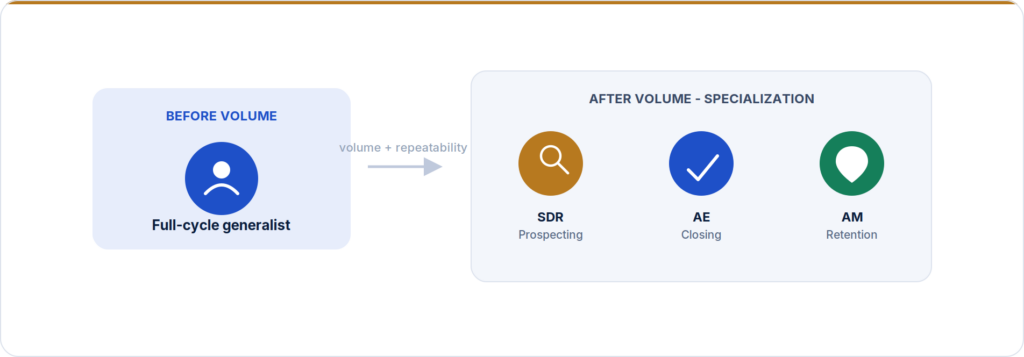
Specialization gives you measurability – you can see exactly which stage is broken, and it simplifies hiring: you’re looking for a specialist for a task, not a unicorn. Turning it on too early just keeps the bottleneck on you.
The contradiction dissolves once you stage it. Ross’s model is the destination, not the starting point. Coming out of founder-led you have neither the volume nor a dialed-in motion to split roles; you need a generalist-builder who runs the whole cycle and builds the process as they go. An SDR hired too early will produce meetings but not revenue, and the bottleneck stays with you. There is only one correct order: first a full-cycle generalist, and only after the motion becomes repeatable and volume shows up, specialization into SDR / AE / AM.
Step 9. Once you hire, do not leave sales
The number-one mistake right after hiring is to step aside with relief and “finally focus on the product.” Sales immediately dips. After the hire you should spend no less time on deals than before, but differently: you become the “great middler,” stepping into the large, strategic, and complex deals while handing the flow to your reps.
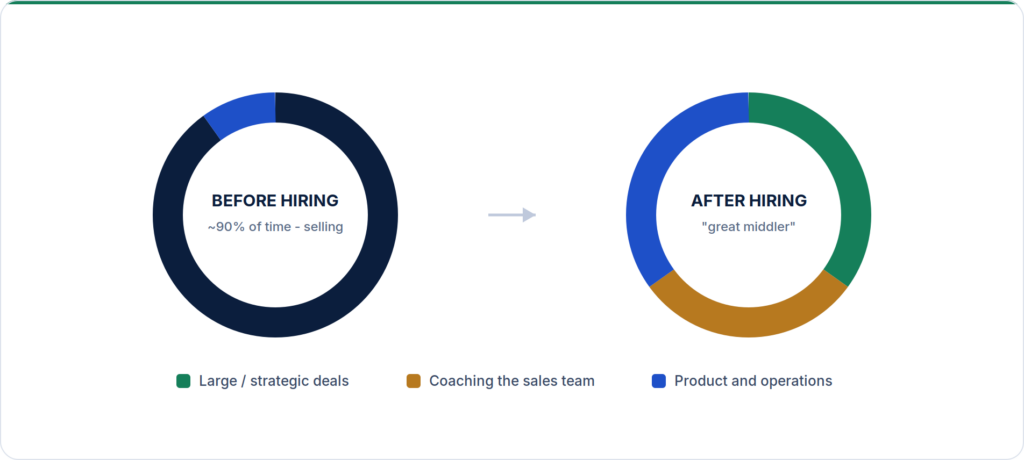
Sales has no economies of scale – headcount grows linearly with revenue. Staying founder-led forever is physically impossible, but so is leaving sales entirely.
Make peace with an unpleasant truth: this frees up less time than you would like. Sales has no economies of scale; headcount grows linearly with revenue, so “staying founder-led forever” is physically impossible, and so is “leaving sales entirely.”
Step 10. The first 90 days and the right to be wrong
A first hire often does not land on the first try; that is not a catastrophe, it is a statistic. Let the new rep fill your calendar with meetings for the first few weeks (you are still the best carrier of the message), then gradually hand off deals. Judge by leading indicators, not closed revenue, until at least one full sales cycle has passed. But do not drag it out of pity: if after two ramps the person shows neither results nor a trajectory, that is usually a question of fit for the role, not “let’s wait a bit longer.”
A note on IT services and outsourcing
Everything above applies to services, but with adjustments that are decisive for outsourcing and white-label development:
- You are selling trust and the ability to deliver, not a product. That makes Lemkin’s test even more important here: the client is buying confidence, and if your rep does not convey it, there is no deal.
- The founder’s reputation is the brand. That is why “the builder” and “do not leave sales” hit harder: for the first few years the client is largely buying you.
- The first hire is often a hybrid, BD plus account management, because in services revenue grows not only from new logos but from expanding existing accounts, and the cycle is long and relationship-driven.
- The referral and partner channel carries more weight than in SaaS, but still as a parallel channel, not a replacement. Your own process is what builds the system.
Bottom line
Sales-led is not “hired a rep and exhaled.” It is a deliberate sequence where skipping any step leads straight into that 70% failure rate:
Choose the motion for your ACV → sell it yourself and dump the process into a playbook → confirm the bottleneck really is demand → hire (from your own network) two coachable builders rather than a star VP → get the money right → stay the “middler” yourself → and only then specialize the roles and hire a leader.
Sales are not delegated in a single hire. They are transferred, out of your head and into a system and the right people. The founder who makes that transfer deliberately is the one who turns personal founder selling into a machine that runs without them.
Ready to make the transition deliberately?
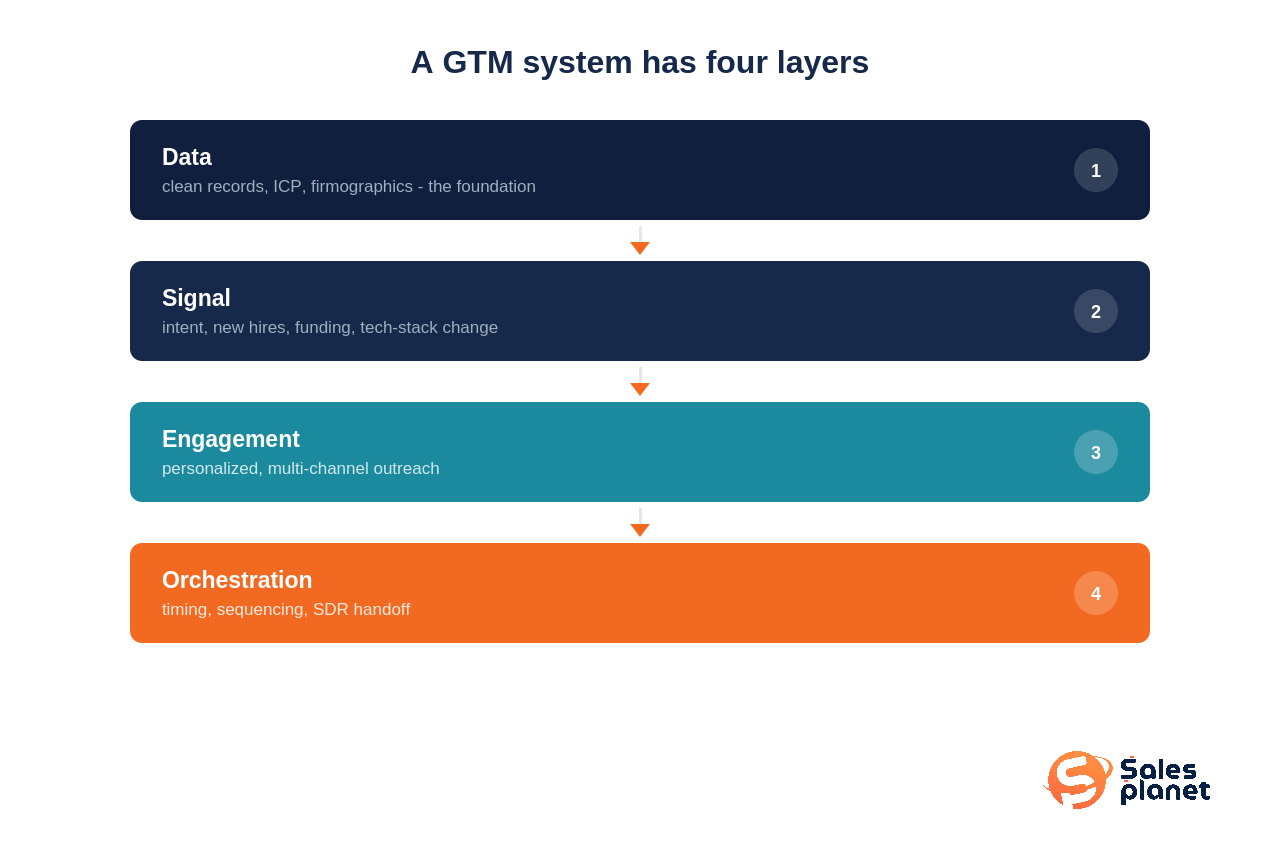
At Sales Planet we help IT and SaaS founders design this exact transition: choosing the right sales motion, extracting the playbook, defining the first-hire profile and comp plan, and running a managed onboarding.
Christoph Janz, Five Ways to Build a $100M Business (Point Nine Capital) · Mark Roberge, The Sales Acceleration Formula · Peter Kazanjy, Founding Sales · Aaron Ross, Predictable Revenue · Jason Lemkin (SaaStr) · Sam Blond (ex-CRO, Brex) · 2026 compensation benchmarks: Bridge Group, RepVue, Everstage.